 ultimate-guide
Coastal Structural Repair: Best Practices Guide
Table of Contents
- Understanding Corrosion in Coastal Environments
- Structural Inspection and Assessment for Waterfront Properties
- Signs of Structural Damage in Waterfront Homes
- Marine Concrete Corrosion Repair Techniques
- Surface Preparation and Material Selection for Coastal Repairs
- Coastal Building Maintenance Checklist and Prevention
- Climate Adaptation and Long-Term Resilience Strategy
- Repair vs. Replacement: Cost-Benefit Analysis
- Frequently Asked Questions
Last Updated: October 2, 2026
Understanding Corrosion in Coastal Environments
Corrosion in coastal areas occurs when salt-laden air and moisture attack exposed materials, particularly reinforced concrete and steel. The primary culprit is chloride-induced corrosion, where salt particles penetrate the building envelope and reach reinforcement bars, triggering oxidation that expands and cracks surrounding concrete.
Waterfront properties face constant salt spray, higher humidity, and cyclical wet-dry cycles that intensify material degradation. Properties within 500 feet of saltwater show measurable corrosion within 5-7 years without proper protective measures.
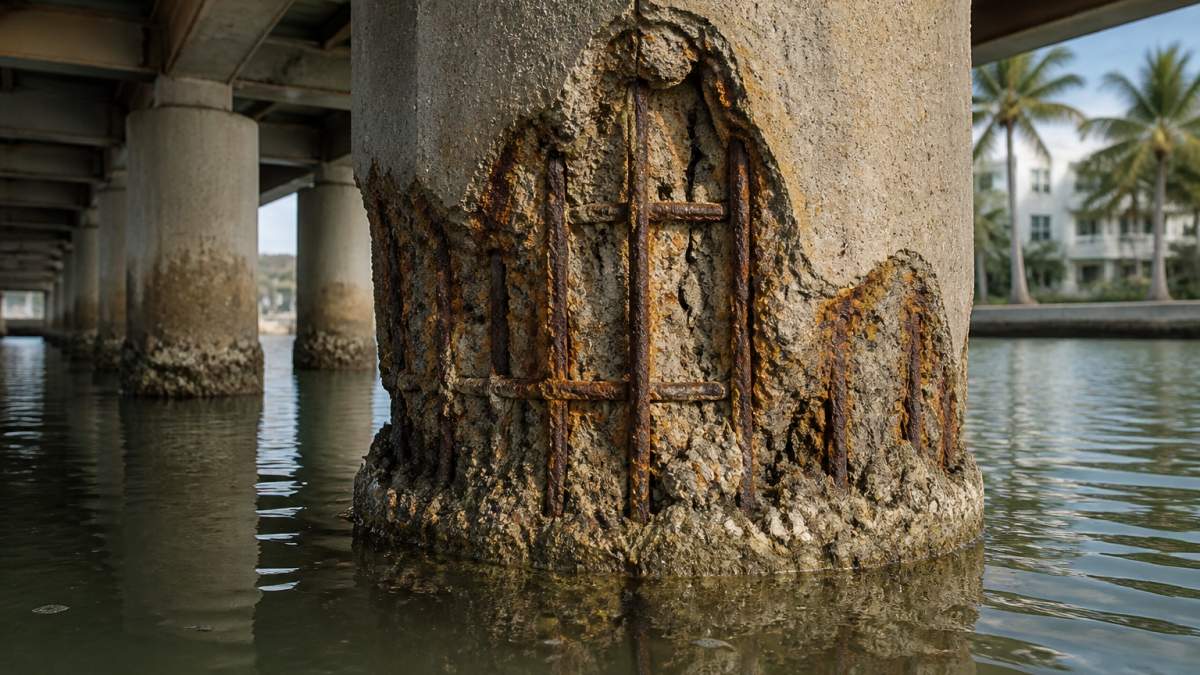
When chlorides reach steel reinforcement, they break down the passive oxide layer protecting it from rust. The steel oxidizes rapidly, expanding as it corrodes and creating internal pressure that spalls concrete. A small patch of rust can eventually compromise an entire structural section.
Prevention through coating systems, drainage management, and moisture control stops corrosion before it starts. Once underway, aggressive intervention is needed: removing contaminated concrete, treating steel, and applying corrosion inhibitors.
Structural Inspection and Assessment for Waterfront Properties
Professional structural inspection for waterfront properties requires chloride testing, concrete cover measurement, and reinforcement bar evaluation, beyond standard residential assessment.
Visual signs like spalling, rust stains, and efflorescence are late-stage indicators. By the time spalling appears, corrosion has penetrated deep, making proactive testing essential for waterfront properties.
Chloride testing measures salt concentration at various depths. A half-inch sample reveals contamination progression and signals active corrosion risk when levels are elevated at reinforcement depth.
Concrete cover, the distance from surface to reinforcement bars, determines protection level. In coastal zones, minimum cover should be 2 inches for salt spray exposure; anything less accelerates deterioration.
Assessment should evaluate the building envelope for cracks, failed sealants, and poor drainage that create moisture pathways and accelerate corrosion.
Signs of Structural Damage in Waterfront Homes
Early warning signs include small cracks, rust stains, and white crystalline deposits (efflorescence), indicating chlorides have reached reinforcement.
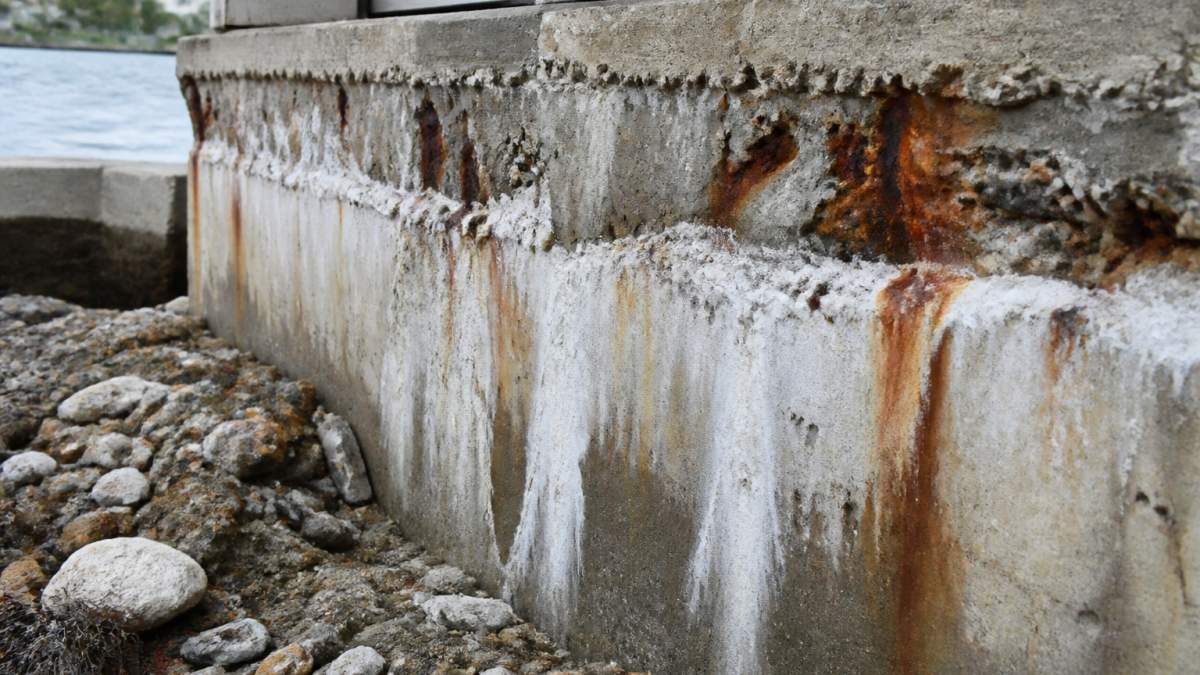
Spalling (concrete flaking away) occurs when corroded reinforcement expands approximately 6 times its original volume, cracking concrete from inside. Spalling accelerates once started because exposed reinforcement corrodes faster.
Delamination, horizontal layer separation, reduces load-bearing capacity and allows deeper water penetration. Hollow-sounding areas when tapping indicate this condition.
Cracks following reinforcement patterns indicate corrosion-driven stress, not random settlement.
Foundation settlement or tilting stems from corrosion damage to pilings or foundation elements, causing uneven settling and visible wall cracks or binding doors.
Moisture problems compound all of these issues. If you notice persistent dampness, efflorescence, or mold growth in basements or crawlspaces, moisture is feeding corrosion. Controlling water ingress is as important as treating the corroded material itself.
Marine Concrete Corrosion Repair Techniques
Coastal structural repair requires removing contaminated concrete, treating exposed reinforcement, and applying protective coatings. Scope depends on corrosion progression.
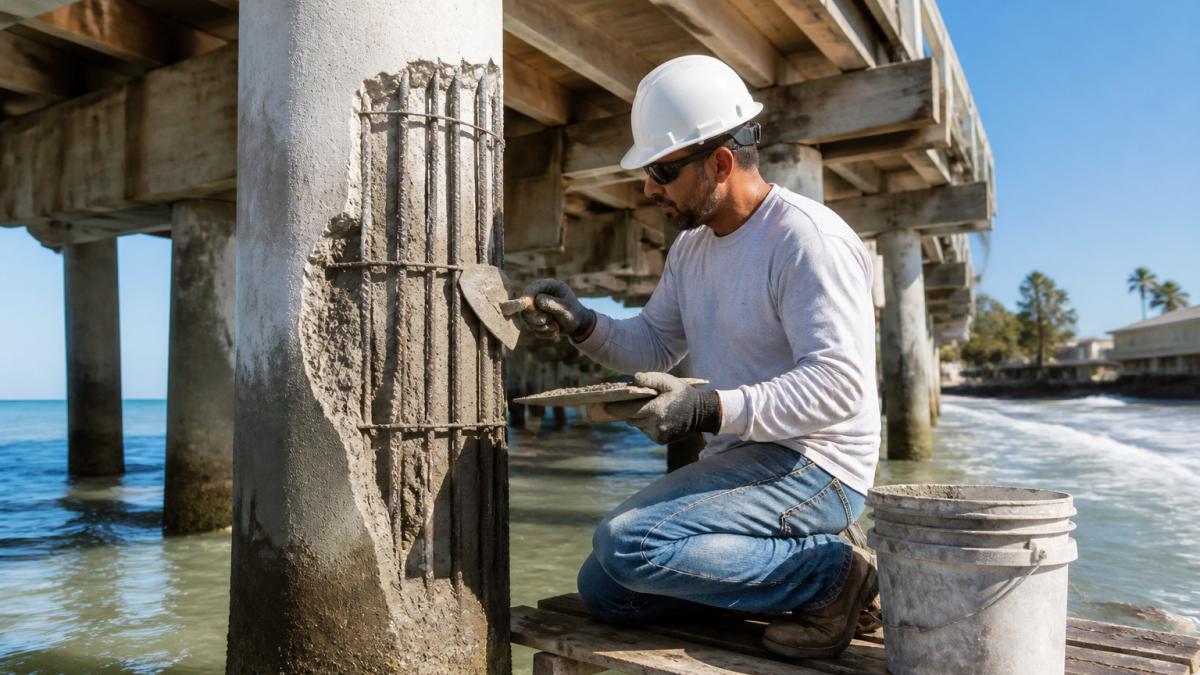
For localized corrosion, workers remove concrete at least 1 inch beyond visible corrosion, creating a cavity for reinforcement inspection and treatment.
Steel is cleaned with wire brushing or light grinding, then coated with a corrosion inhibitor like zinc-rich epoxy or rust-converting primer to form a protective barrier.
The cavity is filled with salt-resistant marine-grade mortar containing corrosion inhibitors and low permeability, requiring proper surface preparation and curing for bond strength.
For extensive corrosion, cathodic protection systems apply electrical current to reinforcement, stopping corrosion at the source. Expensive but effective when large-section replacement isn't feasible.
Epoxy injection seals moisture pathways but doesn't stop active corrosion; it's supplementary, not primary repair.
Surface Preparation and Material Selection for Coastal Repairs
Success in coastal structural repair depends on thorough surface preparation; poor prep undermines materials while meticulous prep extends service life.
Ready to move from scope to build? →
Remove contaminated concrete and corrosion products. Feather edges at a 1:1 ratio to improve adhesion and reduce stress concentrations at repair boundaries.
The concrete surface must then be cleaned of all dust, salt deposits, and contaminants. Pressure washing removes surface debris, but chloride-contaminated concrete requires additional treatment. Some specifications call for salt-contaminated concrete to be rinsed multiple times to reduce chloride concentration before repair.
Surface profile matters. The concrete should have a medium profile, slightly rough, like medium-grit sandpaper, to provide mechanical key for the repair material.
Coastal Building Maintenance Checklist and Prevention
Preventing corrosion is far more cost-effective than repairing it. A structured maintenance schedule catches problems early and extends structural life by decades.
Monthly inspections:
- Visual scan for new cracks, spalling, or rust stains
- Check for water pooling or drainage failures
- Inspect sealants around windows, doors, and penetrations for gaps or deterioration
Quarterly maintenance:
- Clean gutters and downspouts to ensure water flows away from the structure
- Inspect and clean drainage systems around foundations
- Check caulking and sealants; reapply where deteriorated
- Wash salt deposits from exterior surfaces with fresh water
Annual professional assessment:
- Hire a structural engineer to inspect for signs of corrosion or moisture intrusion
- Test concrete chloride levels in high-risk areas
- Evaluate reinforcement bar condition in accessible locations
- Review and repair any failed protective coatings
Every 3-5 years:
- Recoat exterior concrete with protective epoxy or polyurethane system
- Repair minor cracks before they propagate
- Upgrade drainage systems if performance is declining
- Inspect and maintain cathodic protection systems if installed
Every 7-10 years:
- Comprehensive structural assessment including detailed corrosion evaluation
- Replace failed sealants and caulking throughout the building envelope
- Refresh protective coatings on all exposed concrete and steel
Climate Adaptation and Long-Term Resilience Strategy
Coastal properties face increasing climate pressures. Rising sea levels, intensified storm surge, and higher salinity in groundwater all accelerate corrosion. Building resilience into your structure now protects against these evolving threats.
Repair vs. Replacement: Cost-Benefit Analysis
The decision to repair or replace a corroded structural element depends on damage extent, remaining useful life, and financial constraints. Both options have merit; the right choice depends on your specific situation.
Repair works best when:
- Corrosion affects less than 20% of the structural element
- Reinforcement bars retain adequate cross-section and load capacity
- The element's original design still meets current code requirements
- Access for repair work is feasible without major disruption
Replacement becomes necessary when:
- Corrosion is extensive, affecting more than 30-40% of the element
- Reinforcement has lost significant cross-section, reducing load capacity below current code minimums
- Multiple failures are occurring simultaneously, suggesting systemic deterioration
- The element is nearing the end of its design life anyway
Financial analysis should include:
- Direct repair or replacement cost
- Timeline and disruption impact
- Expected remaining service life after repair
- Ongoing maintenance requirements and costs
- Risk of additional failures if only partial repair is done
Frequently Asked Questions
What are the most common causes of structural failure in coastal buildings?
Chloride-induced corrosion is the primary culprit in coastal structural failure. Saltwater exposure accelerates the breakdown of reinforced concrete through two mechanisms: direct salt penetration and carbonation that reduces concrete's protective alkalinity. Secondary causes include moisture ingress, hydrostatic pressure from storm surge, and freeze-thaw cycles. Reinforcement bar corrosion weakens load-bearing capacity and causes spalling and delamination, ultimately compromising structural integrity.
How does saltwater corrosion affect reinforced concrete structures?
Saltwater corrosion attacks both the concrete matrix and embedded reinforcement. Chloride ions penetrate the concrete surface, reaching the steel reinforcement and initiating corrosion. This creates rust, which expands and cracks the surrounding concrete. The process accelerates in high-salinity environments and is compounded by wet-dry cycles typical of coastal zones.
What materials are best for structural repairs in high-salinity environments?
Salt-resistant mortar, epoxy-coated reinforcement, and carbon fiber strengthening systems are industry standards. For concrete repairs, epoxy injection provides strong bond strength and permeability control. Materials must meet serviceability limit state requirements and withstand seawater exposure without degradation. Always select products tested for marine environments.
How often should coastal structures undergo professional engineering inspections?
Annual inspections are recommended for waterfront properties in high-exposure zones; biennial inspections suffice for secondary coastal areas. After major storms, immediate assessment is critical. Professional engineers evaluate spalling, delamination, moisture ingress, and reinforcement bar condition. Structural health monitoring systems can extend inspection intervals by providing real-time data on load-bearing capacity and environmental stress. Regular maintenance schedules based on inspection findings prevent costly emergency repairs.
What is the role of cathodic protection in coastal structural repair?
Cathodic protection prevents corrosion by making the steel reinforcement the cathode in an electrochemical cell, stopping rust formation at the source. This technique is especially effective for existing structures with advanced corrosion. Sacrificial anodes are installed to corrode preferentially, protecting the underlying steel. Combined with proper substrate preparation and moisture control, cathodic protection extends structural life by decades and is often more cost-effective than full replacement.
Why does an integrated engineering and construction approach reduce coastal repair costs?
When engineers and contractors operate as a single team from assessment through execution, coordination gaps disappear. Engineers design repairs based on actual site conditions and available materials, contractors execute to stamped drawings without field changes, and accountability is unified. This eliminates costly rework, permitting delays, and change orders that typically inflate coastal projects. Clear budget planning from the start prevents the surprise overruns common when engineering and construction are separate.
How do building codes influence coastal structural repair methods?
Building codes set minimum standards for structural integrity, load-bearing capacity, and environmental resilience. Coastal zones require compliance with stricter criteria for wind resistance, salt-spray durability, and serviceability limit states. Engineers must select repair materials and methods that meet or exceed these standards, which often increases upfront costs but ensures long-term durability. Code compliance also affects permitting timelines and inspection requirements.